
How to Pass the Sure Leverage Funding Challenge: A Step-by-Step Guide
Passing a prop firm challenge isn't about being a genius trader — it's about understanding the exact rules of the account you bought and trading in a way that never puts you in breach of them. This guide walks through how the Sure Leverage Funding (SLF) 1-Step and 2-Step Challenges work, and how to approach them with a plan instead of guesswork. https://sureleveragefunding.com
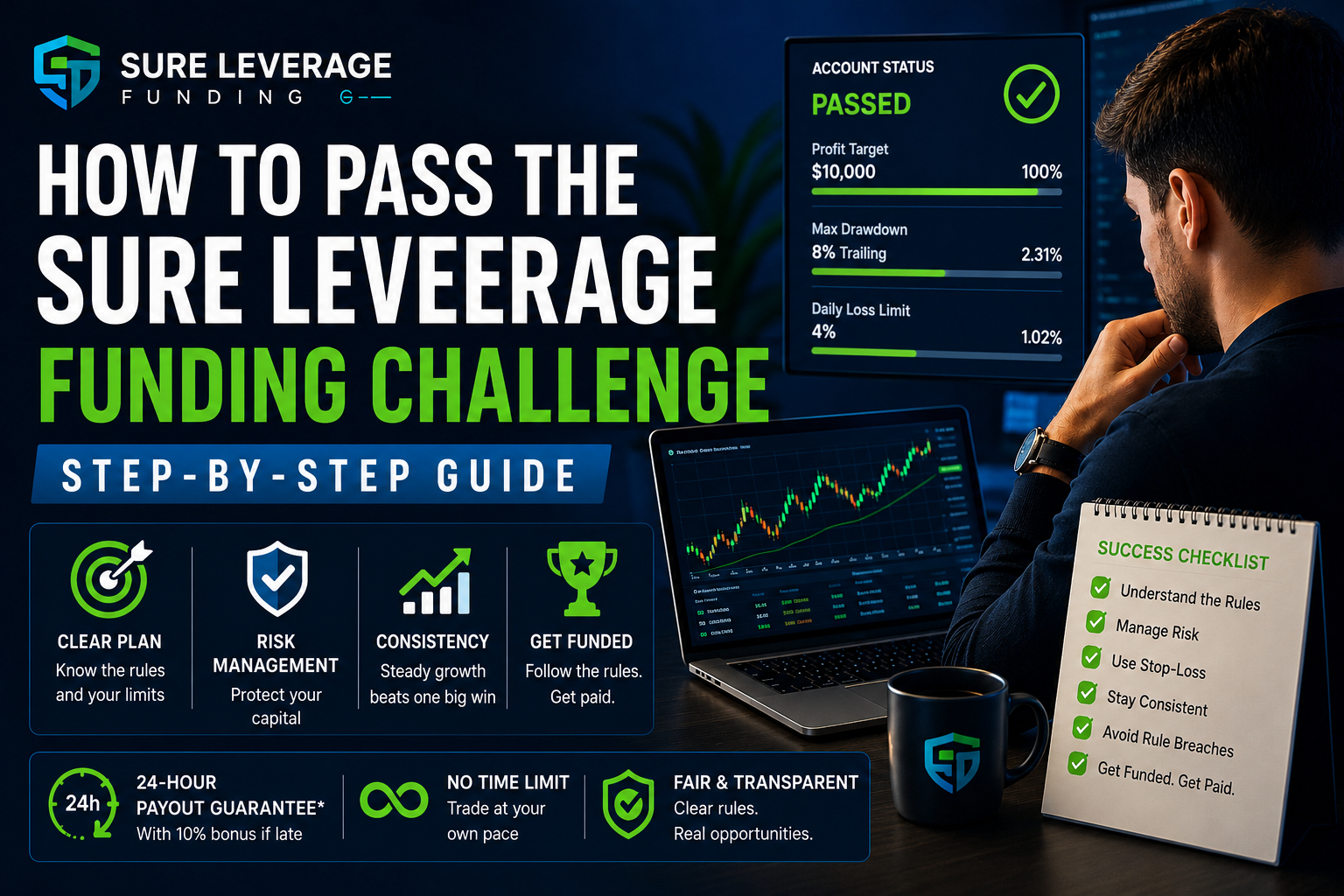
Step 1: Pick the Right Challenge Type for Your Style
SLF offers several evaluation formats, and choosing the wrong one for your trading style is one of the most common reasons traders fail:
1-Step Challenge — single-phase, no time limit, 8% trailing max drawdown, 4% max daily loss. Best for traders who want to get funded faster with one evaluation phase.
2-Step Challenge — two phases, no time limit, 10% fixed max drawdown (doesn't trail), 5% max daily loss. Best for traders who prefer a fixed drawdown that doesn't tighten as they profit.
EA Challenge — for traders who rely on automated strategies during the evaluation phase (MT5 only). Note that EAs are not allowed once funded.
Instant Funding — no evaluation phase at all, but typically comes with tighter risk parameters since there's no "proving period."
If you're a discretionary swing trader, the 2-Step's fixed (non-trailing) drawdown is usually more forgiving than a trailing drawdown once you're in profit. If you want to get to a funded account fastest, the 1-Step is the more direct route. https://sureleveragefunding.com
Step 2: Understand Your Drawdown Limits Before You Place a Single Trade
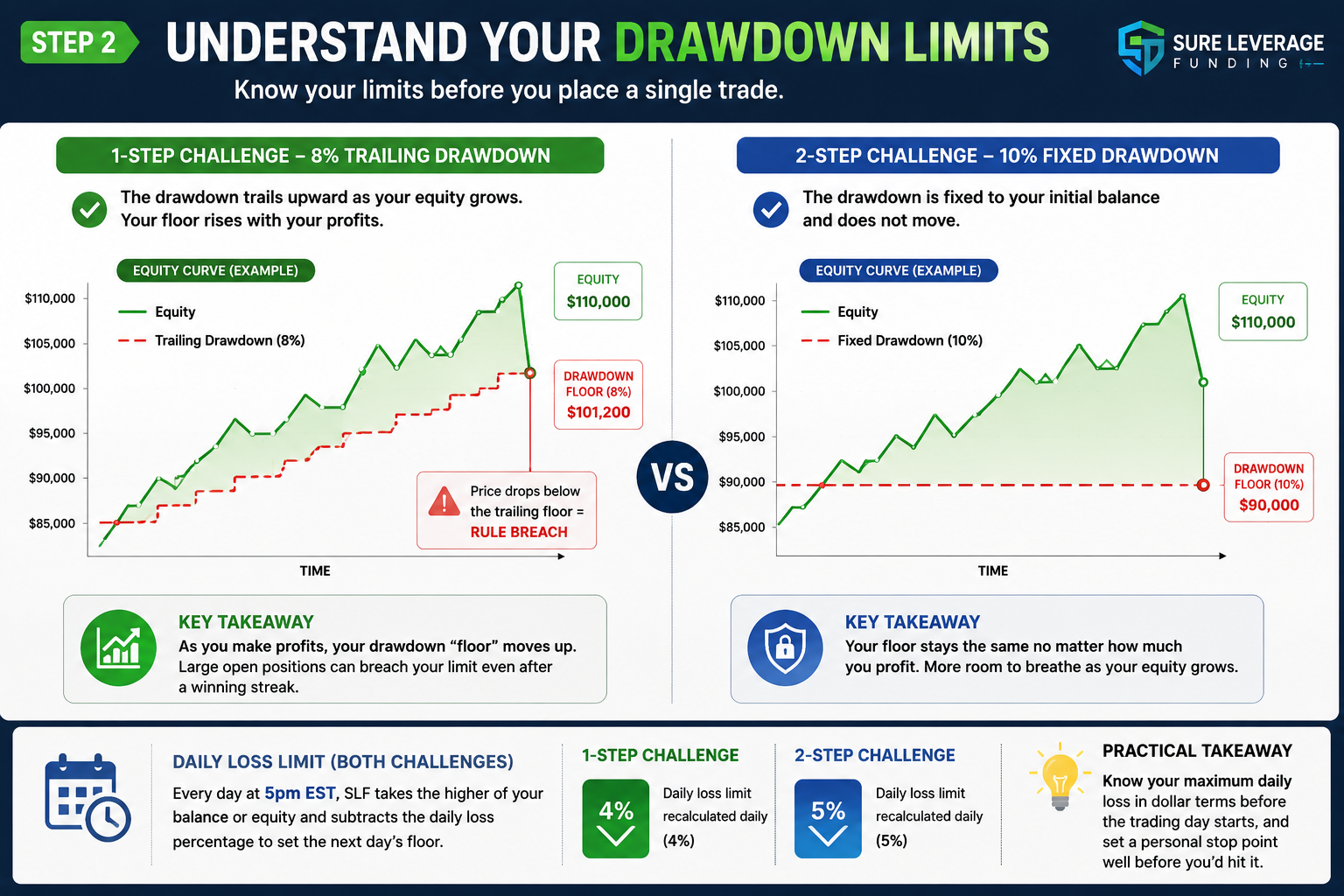
This is the single most important step. On the 1-Step Challenge, the 8% max drawdown trails upward as your balance/equity grows — meaning your "floor" rises as you profit, so open, oversized positions can catch you out even after a winning streak. On the 2-Step Challenge, the 10% max drawdown is fixed to your initial balance and does not move.
Daily loss limits are recalculated every day at 5pm EST, using the higher of your balance or equity at that time, minus the daily loss percentage (4% on the 1-Step, 5% on the 2-Step). Practical takeaway: know your maximum daily loss in dollar terms before the trading day starts, and set a personal stop point well before you'd hit it.
Step 3: Always Use a Real Stop-Loss
Once funded, SLF requires a stop-loss on every trade, set within 5 minutes of entry. "Fake" stop-losses — placed so far away that a hit would blow through your drawdown limit anyway — are explicitly against the rules and can trigger a rule breach. Build the habit of setting genuine, risk-appropriate stop-losses during the evaluation phase too, even though it's only strictly required on funded accounts. It trains the exact risk discipline you'll need later.
Step 4: Respect the Consistency Rules
Many traders pass the drawdown and profit target but still run into issues at payout because they didn't understand consistency rules:
Multiple trades in the same direction, on the same pair, opened close together, are treated as one single "Trade Idea" — their lots and profit are combined when checking consistency, not counted separately.
Depending on the program, there may be a rule that no single trading day can account for an outsized share of your total profit (for example, some programs cap this around 25% of total profit for that payout period).
Practical takeaway: avoid concentrating all your profit in one huge trade or one lucky day. Spread your winning trades across multiple sessions and multiple, genuinely independent setups.
Step 5: Know What Happens If You Break a Rule
SLF uses a "soft breach" system rather than instantly closing your account for every infraction. If you break a rule (lot consistency, stop-loss rule, etc.), the profit from that specific trade is deducted from your total profit at payout time — not your whole account balance. If total deductions are less than your profit, you still get paid a reduced amount. If deductions exceed your profit, the payout for that period is denied. Accumulate too many soft breaches (20+) or have 50%+ of your trades in breach, and the account can be closed. Knowing this system exists should change your behavior: one accidental breach won't wipe you out, but a pattern of sloppy rule-following will.
Step 6: Avoid Prohibited Strategies Entirely
Certain strategies are disallowed on funded accounts, including tick scalping, latency/reverse arbitrage, and martingale-style position doubling. Even if these strategies technically hit a profit target during a challenge, they're flagged during compliance review and can result in disqualification. Build your strategy around genuine, repeatable price analysis — not exploiting execution mechanics.
Step 7: Plan Around the No-Time-Limit Advantage
Both the 1-Step and 2-Step Challenges have no time limit, which removes the pressure to "force" trades to hit a deadline. Use this to your advantage: wait for genuinely high-probability setups instead of trading just to make progress. Time pressure is one of the biggest causes of rule breaches and drawdown blowouts in prop firm challenges generally.
Step 8: Request Your Payout Correctly
Once you've hit your profit target without breaching drawdown rules, and you pass KYC verification, you'll be funded. On programs that support instant payout requests (1-Step, 2-Step, Instant Funding), you can request a payout as soon as requirements are met, and SLF's 24-hour payout guarantee applies — with a 10% bonus on your profit split if that window is missed for reasons other than weekends, holidays, or compliance checks
Quick Pre-Challenge Checklist
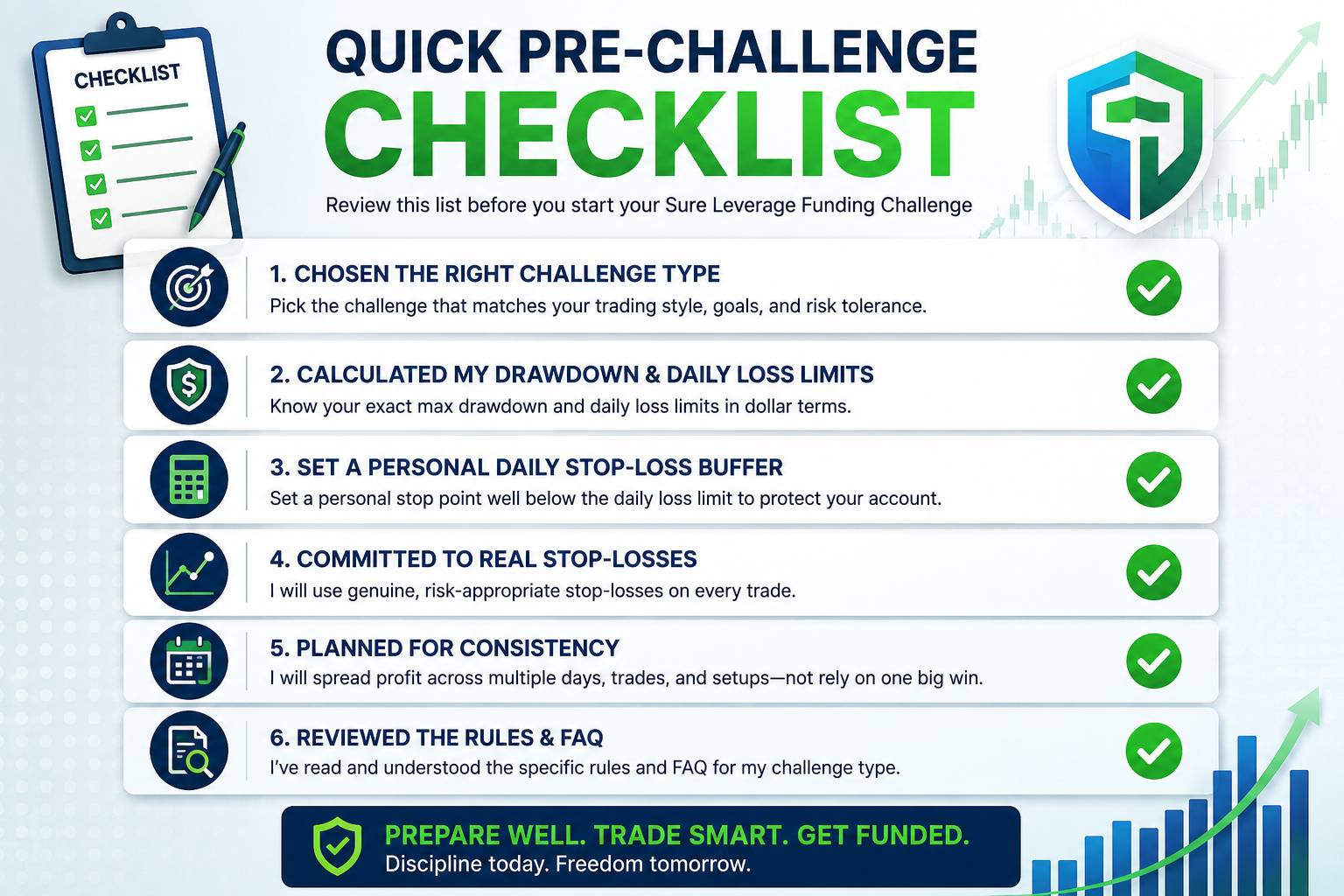
Chosen the challenge type that matches your strategy and risk tolerance
Calculated your exact max drawdown and daily loss limits in dollar terms
Set a personal daily stop-loss buffer below the official limit
Committed to genuine stop-losses on every trade
Planned to spread profit across multiple days/trades, not one big win
Reviewed the specific FAQ page for your exact challenge type before trading
https://sureleveragefunding.com — place as a closing CTA button/banner here.
Frequently Asked Questions
Is there a time limit on the Sure Leverage Funding Challenge?
No — both the 1-Step and 2-Step Challenges have no time limit for completing the evaluation phase.
What happens if I breach a rule but I'm still profitable overall?
SLF deducts the profit tied to the specific breached trade rather than closing the account outright, as long as deductions don't exceed your total profit and you haven't accumulated excessive breaches.
Can I use an Expert Advisor (EA) to pass the challenge?
Only on the EA Challenge program (MT5 only), and only during the evaluation phase — EAs are not permitted once you're funded.
How is the daily loss limit calculated?
Every day at 5pm EST, SLF takes the higher of your balance or equity and subtracts the daily loss percentage for your challenge type (4% on the 1-Step, 5% on the 2-Step) to set the next day's floor.

About the author
Bestora Senior Trends AnalystAbout the author – bestora Team
Couponflowx Team is a group of independent researchers and writers who review products and services across different industries. Our content is based on publicly available information and careful analysis, with the goal of helping readers understand what a product offers before making their own decisions.